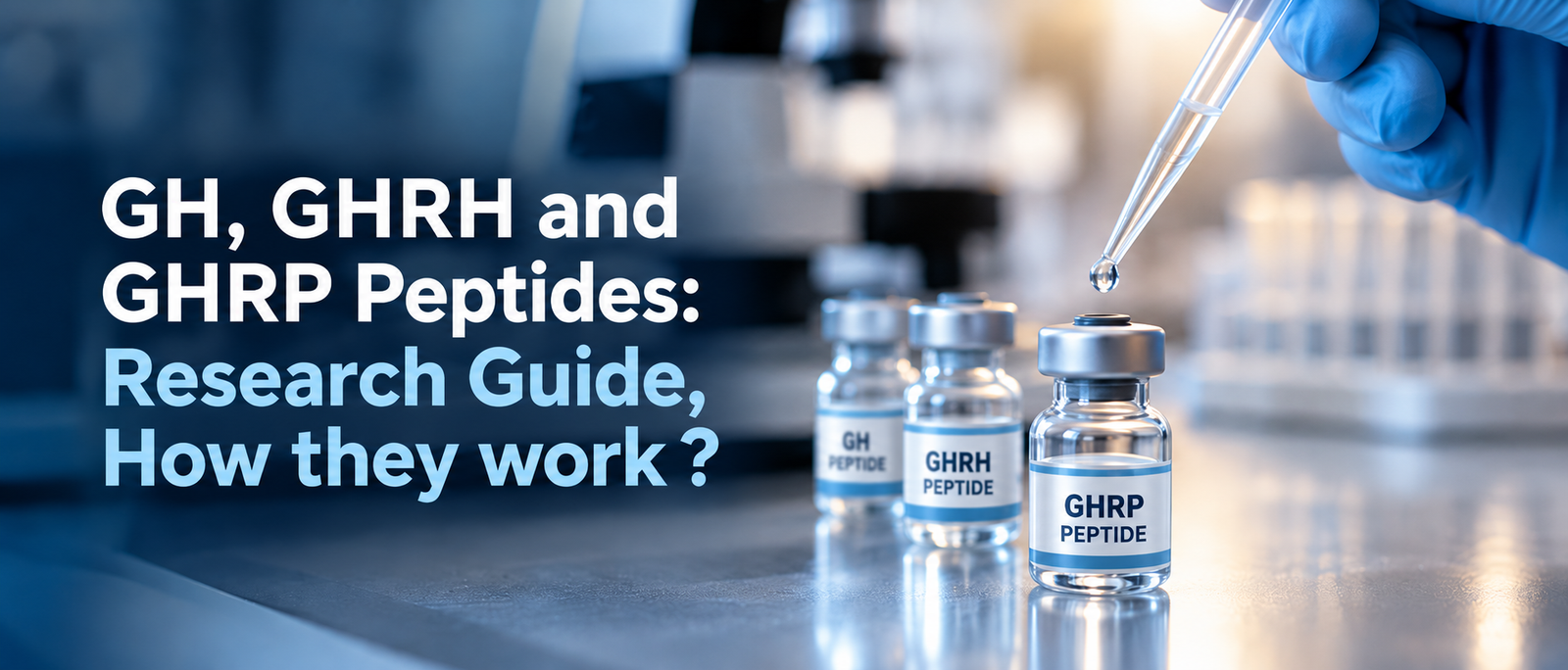
Research on Growth hormone has evolved beyond studying Growth Hormone (GH) alone. Today, researchers also study Growth Hormone-Releasing Hormone (GHRH) and Growth Hormone-Releasing Peptides (GHRPs) to better understand the regulation of GH secretion, metabolism, growth and tissue physiology.
These peptides are closely related and each works through a distinct biological mechanism. Understanding these differences helps researchers to select the appropriate peptide for specific research purposes.
GH vs. GHRH vs. GHRP: Comparison
| Growth Hormone (GH) | Growth Hormone Releasing Hormone (GHRH) | Growth Hormone Releasing Peptide (GHRP) |
|---|---|---|
| Natural peptide hormone secreted by anterior Pituitary Gland | Natural Hypothalamic hormone stimulates the release of GH | Synthetic peptide stimulates the secretion GH through activation ghrelin receptor of |
| Stimulates Insulin like growth factor (IGF 1) production | Stimulates natural GH release | Stimulates GH release |
| Promotes muscle growth, tissue repair, bone health, energy metabolism. | Helps in Natural GH secretion, endocrine regulation, healthy aging | Promotes GH pulsatility, and investigated for metabolism, tissue regeneration, body composition. |
(Devesa, Almengló, Devesa, & Diabetes, 2016), (Merriam, Schwartz, & Vitiello, 2003), (Smith et al., 1997).
GHRH and GHRP Synergy
The interaction between GHRH and GHRP pathways is an important area of growth hormone research. Researchers study this combination because these stimulate growth hormone release through different yet complementary biological pathways.
GHRH primarily acts through the GHRH receptor on pituitary somatotrophs, whereas GHRPs and related growth hormone secretagogues act through the growth hormone secretagogue receptor (GHS-R) pathway.
Potential Research Applications
- Investigates the mechanism regulating pulsatile secretion of GH
- Explores the increased production of IGF-1
- Explores mechanisms of tissue growth and physiology
- Evaluates body composition changes
- Investigates muscle protein development
- Advances research on endocrine physiology
Clinical benchmark
Clinical and experimental studies have demonstrated that GHRH and GHRP pathways can interact synergistically in stimulating GH secretion. Early human studies demonstrated that combined GHRH and GHRP administration could produce a stronger GH response than either stimulus alone.
However, these findings describe research into endocrine mechanisms and should not be interpreted as evidence that combining these peptides is an established clinical intervention. Further well-controlled research is required to characterize their long-term effects, safety, and potential therapeutic applications.
For research Use Only: The discussion of GHRH & GHRP stacking is intended solely for scientific and laboratory research. It should not be interpreted as a recommendation for personal or clinical use.
References
Devesa, J., Almengló, C., Devesa, P. J. C. M. I. E., & Diabetes. (2016). Multiple effects of growth hormone in the body: is it really the hormone for growth? , 9, CMED. S38201.
Merriam, G. R., Schwartz, R. S., & Vitiello, M. V. J. E. (2003). Growth hormone-releasing hormone and growth hormone secretagogues in normal aging. 22(1), 41-48.
Smith, R. G., Van der Ploeg, L. H., Howard, A. D., Feighner, S. D., Cheng, K., Hickey, G. J., . . . Patchett, A. A. J. E. r. (1997). Peptidomimetic regulation of growth hormone secretion. 18(5), 621-646.