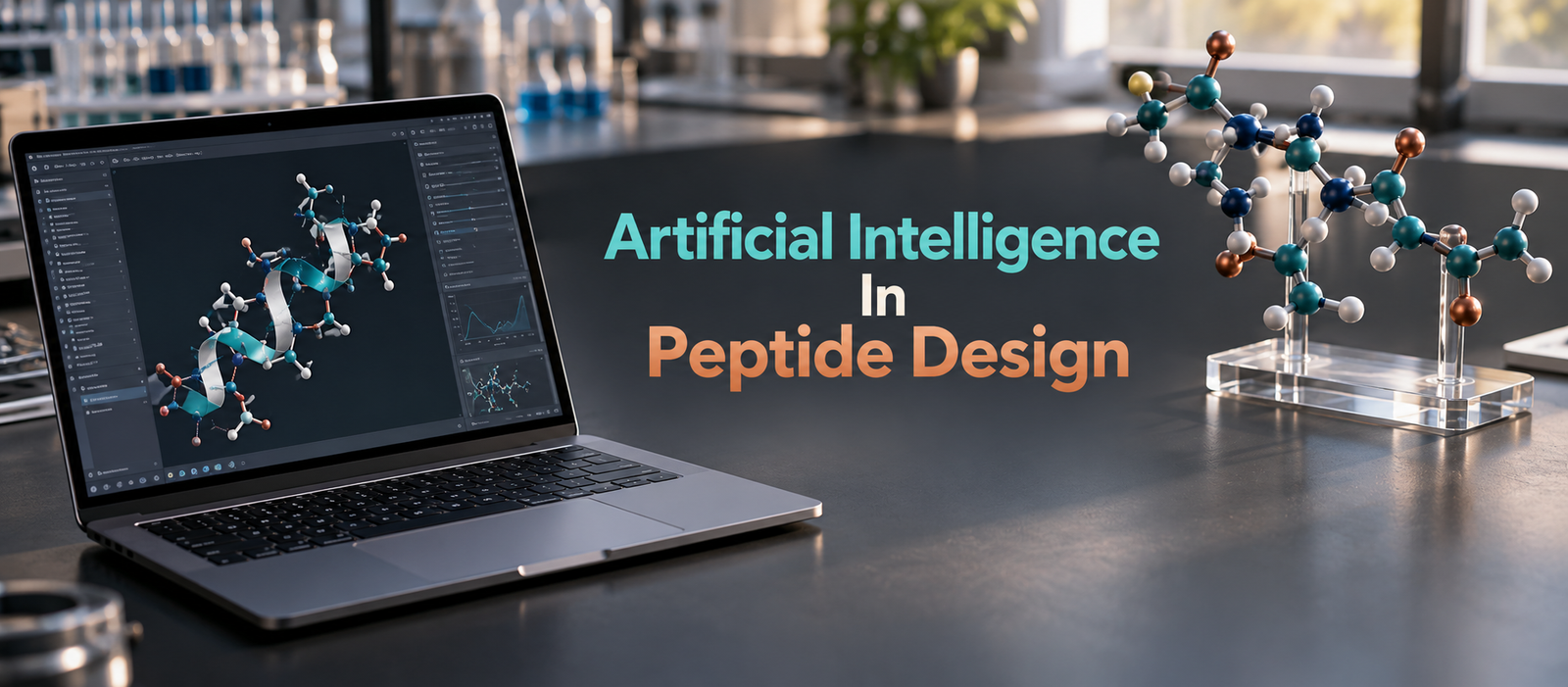
The discovery of peptides is entering a new era. Nowadays, researchers use Artificial Intelligence (AI) to design and evaluate peptides computationally before laboratory testing. This can help researchers reduce the number of candidates that need to be tested experimentally.
AI can help make peptide design more efficient. It can be used to predict peptide structure, study peptide–receptor interactions, and identify potential toxicity risks.
At A Glance How AI Helps?
| Function Of AI | What It Helps Researchers |
|---|---|
| Finding the right shape of peptides | AI predicts how a peptide may fold and what shape it will adopt |
| Hitting the target | Predicts how strongly a peptide may interact with a target protein |
| Safety concerns | Identifies potential toxicity risks early |
Predicting Peptide Shapes
A peptide often needs a suitable structure to interact with its target protein.
- Computer Modeling: AI can predict the 3D shape of a peptide before it is physically made in a laboratory.
- Faster Decisions: Scientists can prioritize peptide candidates for laboratory testing based on computational predictions.
Improving Binding With Target
An effective peptide may need to interact with its target while limiting unwanted interactions.
- Target Interaction: AI can help predict and optimize peptide interactions with target proteins.
- Potential Selectivity: Computational methods may help identify candidates with more selective target interactions.
Reduce Toxicity
Not every peptide with strong target activity will be suitable for further drug development.
Early Safety Check: AI can help predict for any toxicity of peptides.
Saving Resources: Early predictions may help reduce unnecessary laboratory testing of less promising candidates.
Final Takeaway
AI is not replacing lab testing. It can help researchers prioritize peptide candidates for laboratory testing. AI may make peptide discovery more efficient, but laboratory testing remains essential.
AI Generates Ideas → Predicts Shapes → Filter Safe Options → Test in Lab
Disclaimer: This information is provided only for educational and scientific purposes. Research peptides are intended only for laboratory research and are not approved for human use unless authorized by the relevant regulatory authorities. AI-based predictions do not replace laboratory testing or clinical evaluation.
References
- Goles, M., Daza, A., Cabas-Mora, G., et al. (2024). Peptide-based drug discovery through artificial intelligence: Towards an autonomous design of therapeutic peptides. Briefings in Bioinformatics, 25(4), bbae275. https://doi.org/10.1093/bib/bbae275
- Zhai, S., Liu, T., Lin, S., Li, D., Liu, H., Yao, X., & Hou, T. (2025). Artificial intelligence in peptide-based drug design. Drug Discovery Today, 30(2), 104300. https://doi.org/10.1016/j.drudis.2025.104300