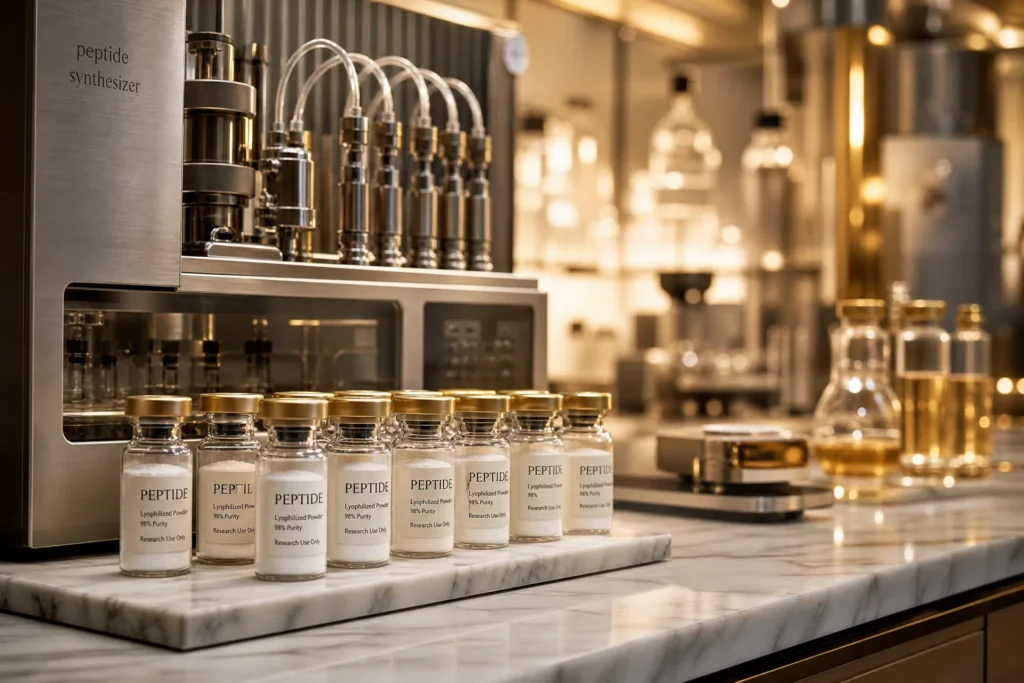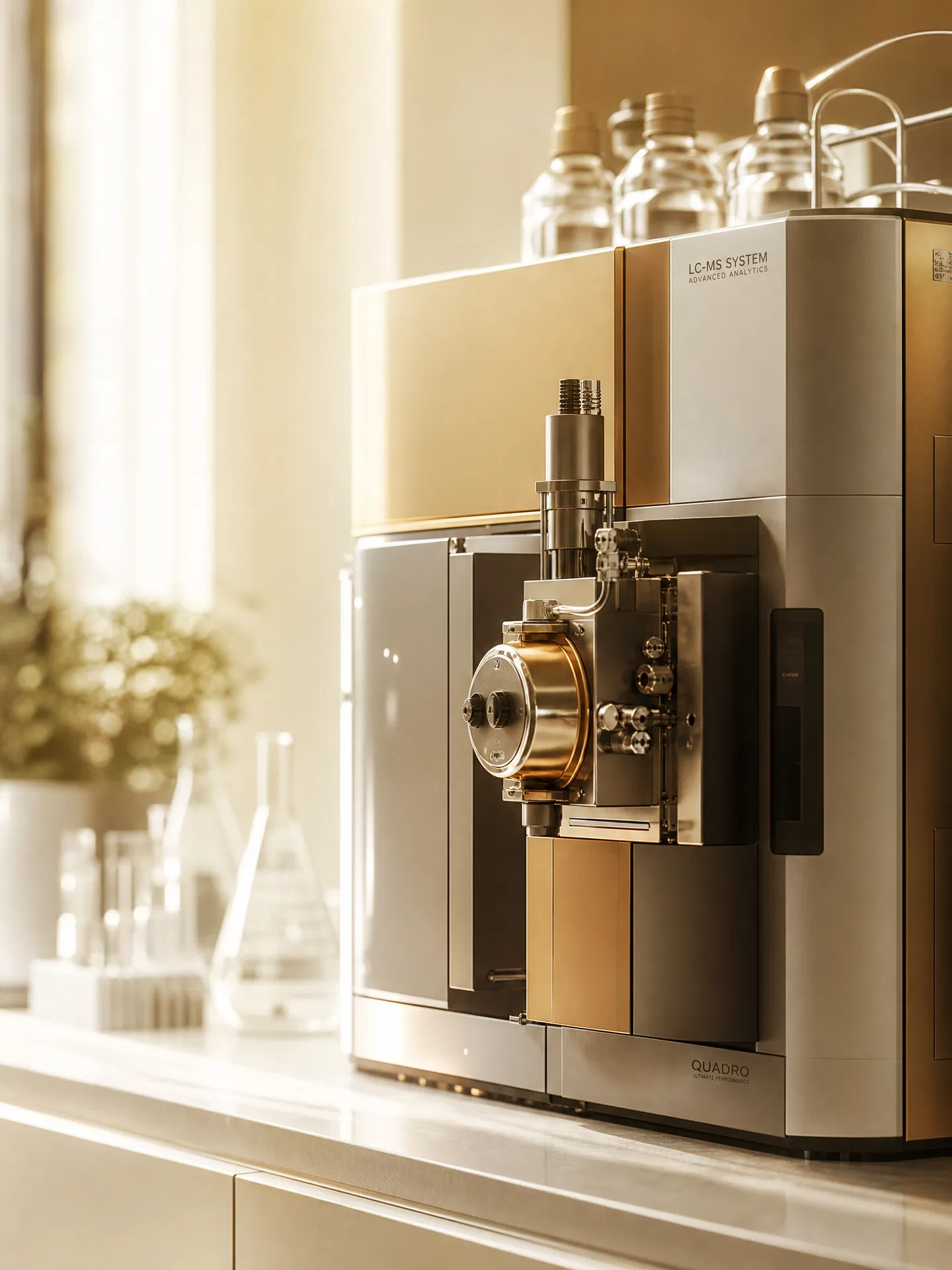
When a vial of research peptide arrives at your lab, the question of purity and identity is not merely academic — it is the foundation of every downstream experiment. Mass spectrometry, and specifically Ultra Performance Liquid Chromatography coupled with Mass Spectrometry (UPLC/MS), is the gold-standard method for answering that question with precision.
What Is Mass Spectrometry?
Mass spectrometry is an analytical technique that measures the mass-to-charge ratio (m/z) of ions. In the context of peptide analysis, a sample is first ionised — typically via electrospray ionisation (ESI) — and the resulting ions are separated by their m/z values in a mass analyser before being detected. The output is a mass spectrum: a plot of ion intensity against m/z, which functions as a molecular fingerprint.
For a peptide like BPC-157 (molecular formula C₆₂H₉₈N₁₆O₂₂), the theoretical monoisotopic mass is known precisely. If the measured mass matches the theoretical value within an acceptable tolerance (typically ±0.5 Da for low-resolution instruments, or ±5 ppm for high-resolution), the peptide’s identity is confirmed.
Why Couple UPLC with MS?
Liquid chromatography separates the components of a mixture before they enter the mass spectrometer. In UPLC, sub-2-micron particle columns and higher operating pressures allow for faster, higher-resolution separations compared to conventional HPLC. This matters because a peptide sample is rarely a single pure compound — it contains the target peptide, synthesis by-products, truncated sequences, and oxidation adducts.
UPLC/MS does not simply confirm that a peptide is present — it quantifies every impurity simultaneously, providing a complete purity profile in a single analytical run.
By coupling UPLC separation with MS detection, analysts can identify each peak in the chromatogram by its exact mass, distinguishing the target peptide from structurally similar impurities that would be invisible to UV detection alone.
Reading a Mass Spec COA
A Certificate of Analysis (COA) generated from UPLC/MS analysis will typically report: the observed molecular weight (with the theoretical value for comparison), the purity percentage as determined by UV absorbance at 220 nm (which detects the peptide bond), and the retention time — the time at which the target compound elutes from the column.
A purity of 99%+ by UPLC/UV means that 99% or more of the UV-absorbing material in the sample is the target peptide. This does not account for non-UV-absorbing impurities such as residual solvents or inorganic salts, which is why a complete COA also includes water content (Karl Fischer) and residual solvent data.
All Bio Edit compounds are tested by UPLC/MS at an independent third-party laboratory. COAs are available for every batch on our Lab Results page.
Why This Matters for Research
Reproducibility is the cornerstone of scientific research. If the compound used in an experiment is not what it claims to be — or contains significant impurities — the results cannot be reliably interpreted or replicated. Mass spectrometry provides the level of analytical certainty that research-grade compounds demand.
For researchers working with peptides in in-vitro assays or animal model studies, the purity and identity of the compound are not simply quality metrics — they are experimental variables. A 95% pure peptide is a different compound from a 99%+ pure one, and the 5% impurity fraction may have biological activity of its own.
Conclusion
Mass spectrometry is not a luxury in peptide quality control — it is a necessity. UPLC/MS analysis provides simultaneous identity confirmation and purity quantification in a single analytical run, offering a level of certainty that no other technique can match. When evaluating a peptide supplier, the presence of UPLC/MS data on the COA is one of the most important indicators of analytical rigour.