High Performance Liquid Chromatography (HPLC) is the most widely used analytical technique for assessing the purity of synthetic peptides. Understanding how it works — and how to interpret the data it produces — is essential for any researcher working with research-grade compounds.
How HPLC Works
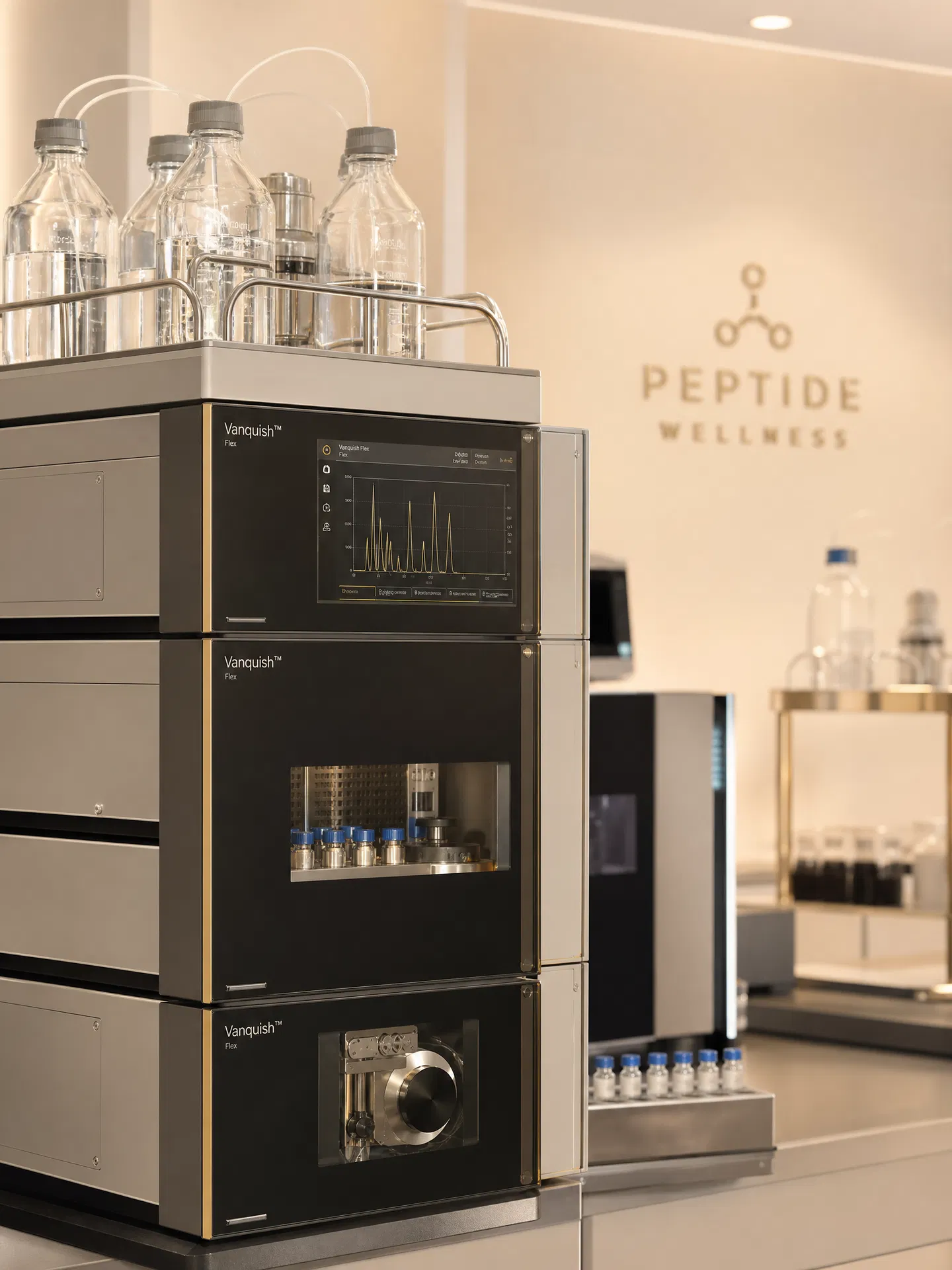
HPLC separates the components of a mixture by passing a liquid sample (the mobile phase) through a column packed with a solid material (the stationary phase) under high pressure. Different compounds in the sample interact with the stationary phase to different degrees, causing them to travel through the column at different rates. As each component exits the column (elutes), it is detected — typically by UV absorbance at 220 nm for peptides, which absorbs at the peptide bond.
The result is a chromatogram: a plot of detector signal (y-axis) against time (x-axis). Each peak in the chromatogram represents a distinct compound in the sample. The area under each peak is proportional to the amount of that compound present.
Reversed-Phase HPLC for Peptides
For peptide analysis, reversed-phase HPLC (RP-HPLC) is the standard method. In RP-HPLC, the stationary phase is non-polar (typically C18 — octadecylsilane bonded to silica) and the mobile phase is polar (water/acetonitrile with an ion-pairing agent such as trifluoroacetic acid). Peptides are separated based on their hydrophobicity: more hydrophobic peptides interact more strongly with the C18 stationary phase and elute later.
A well-resolved RP-HPLC chromatogram for a high-purity peptide will show a single dominant peak with a purity area percentage of ≥95%, and ideally 99%+.
Reading a Chromatogram
On a COA, the HPLC purity is typically reported as a percentage: the area of the main peak divided by the total area of all peaks, multiplied by 100. A purity of 99.2% means that 99.2% of the UV-absorbing material eluting from the column is the target peptide. The remaining 0.8% represents impurities — which may include truncated sequences, oxidation products, or synthesis by-products.
The retention time — the time at which the main peak elutes — is also reported. This provides a secondary identity check: if the retention time matches the expected value for the target peptide under the specified chromatographic conditions, it provides additional confidence in the compound’s identity.
HPLC vs. Mass Spectrometry
HPLC provides purity data but does not confirm molecular identity — it cannot distinguish between two compounds with identical retention times. Mass spectrometry (MS) provides identity confirmation by measuring the exact molecular mass of the compound. For this reason, the most rigorous COAs combine HPLC purity data with MS identity confirmation, typically as UPLC/MS analysis.
All Bio Edit compounds are tested by UPLC/MS at an independent third-party laboratory, providing both purity and identity confirmation in a single analysis.
Summary
HPLC is the foundation of peptide purity testing. A COA with HPLC data tells you what percentage of the sample is the target compound. Combined with mass spectrometry, it provides the complete analytical picture: both purity and identity confirmed by independent physical measurements.